


Volute Housing Assembly
Stronger structure, lower noise. 60% greater strength and 30% better quiet performance.

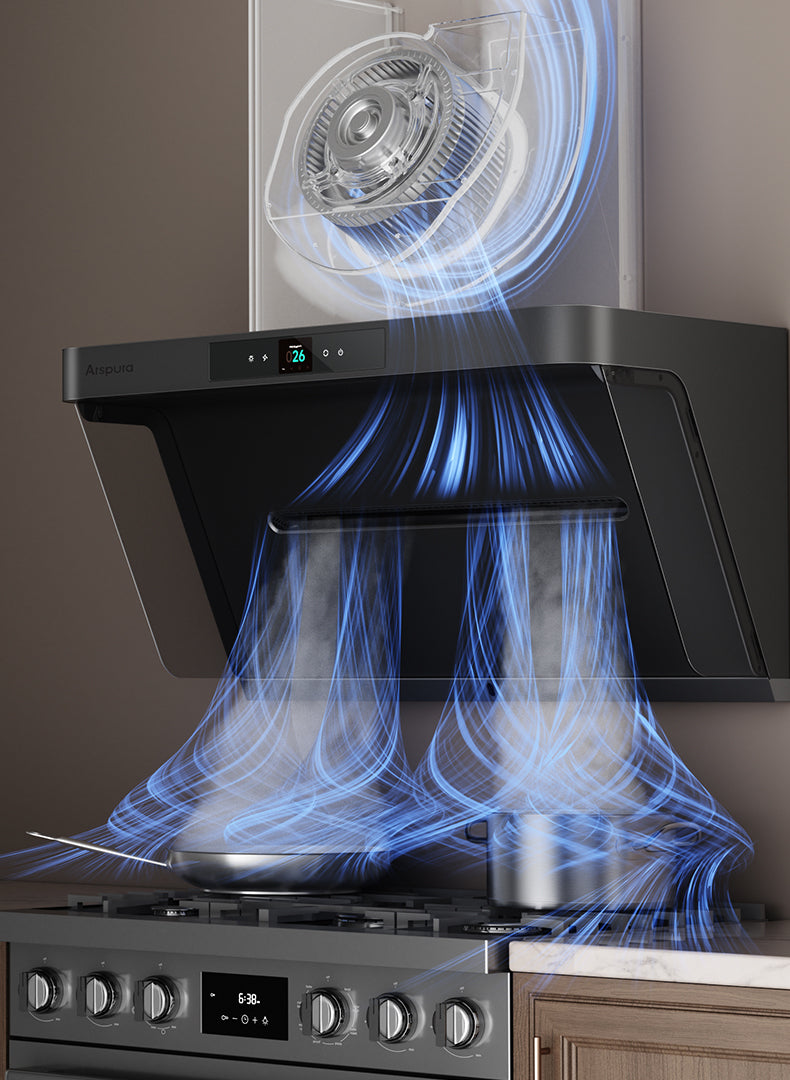
High CFM isn’t everything — 13 m/s -16m/s high-speed suction captures fumes instantly, removing smoke faster and deeper than traditional range hoods(3-5m/s).
Cooking fumes carry PM2.5 and harmful particles. Arspura’s purification system and sensor monitoring ensure healthier air for your family every day.

IQV™ is a precision-engineered airflow system designed to capture cooking smoke before it spreads.
Work together to maximize smoke capture—creating a vortex that locks fumes in instantly.
Far exceeding conventional range hoods at 2.4 m/s—pulls fumes away with tornado-like force.
Powerful anti-interference design blocks disturbances from movement and air drafts—like an invisible air curtain keeping polluted air out.

Top air curtain blocks fumes from reaching the face and nose.

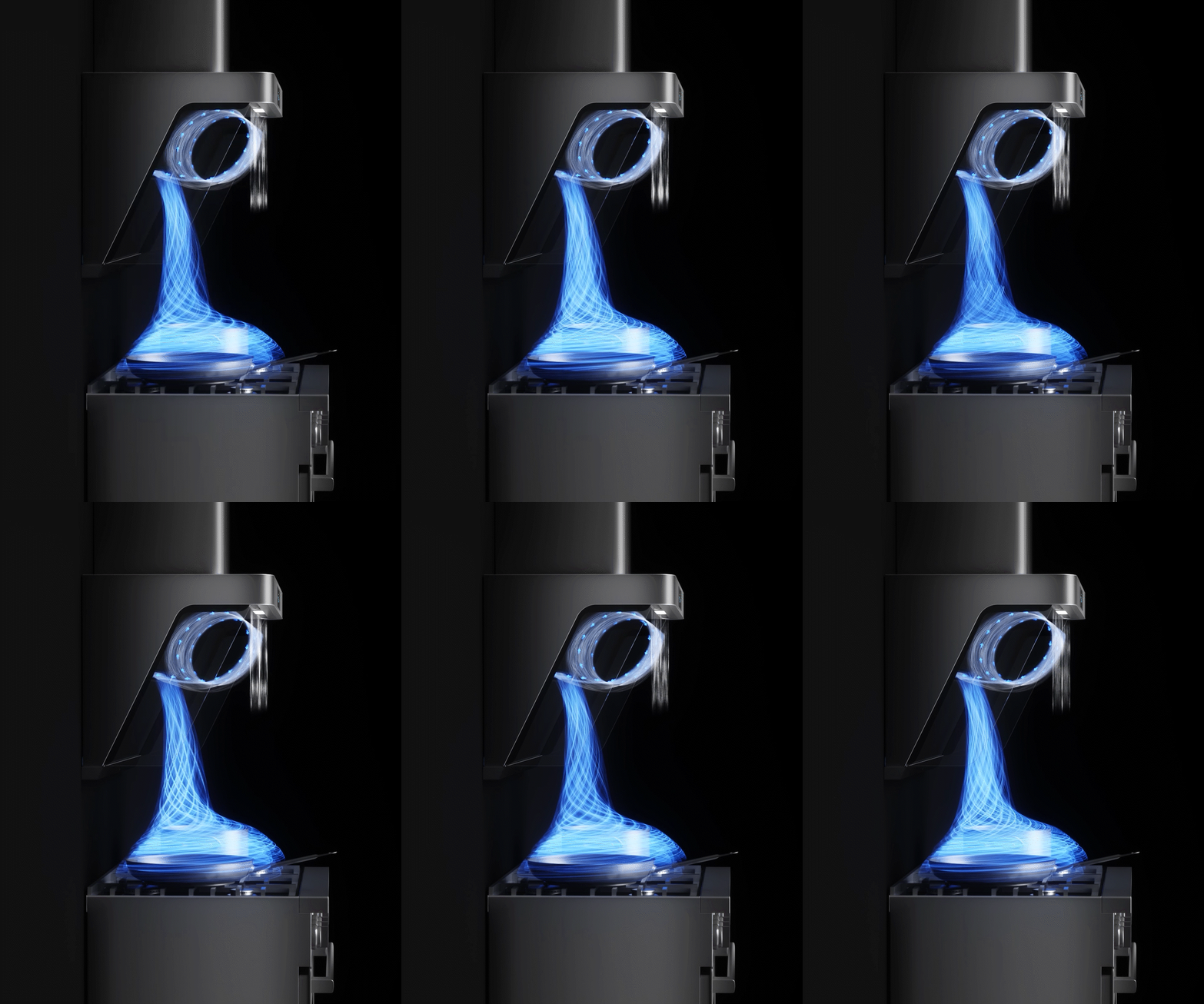
Arspura’s triple-airflow control technology goes beyond traditional single negative-pressure ventilation by generating three coordinated airflow patterns the moment the system starts.

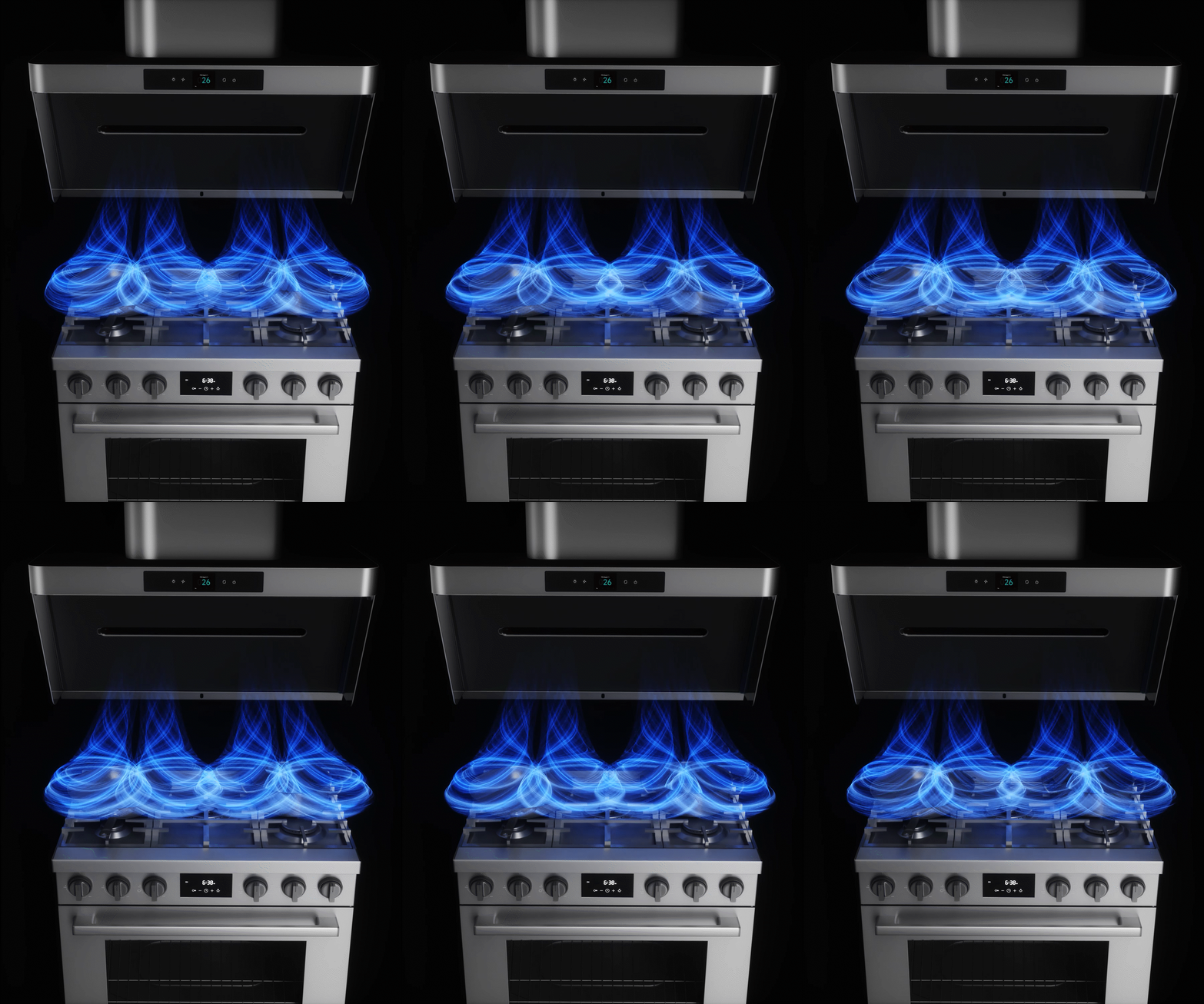
Helps contain cooking smoke and harmful particles at the source before they escape.

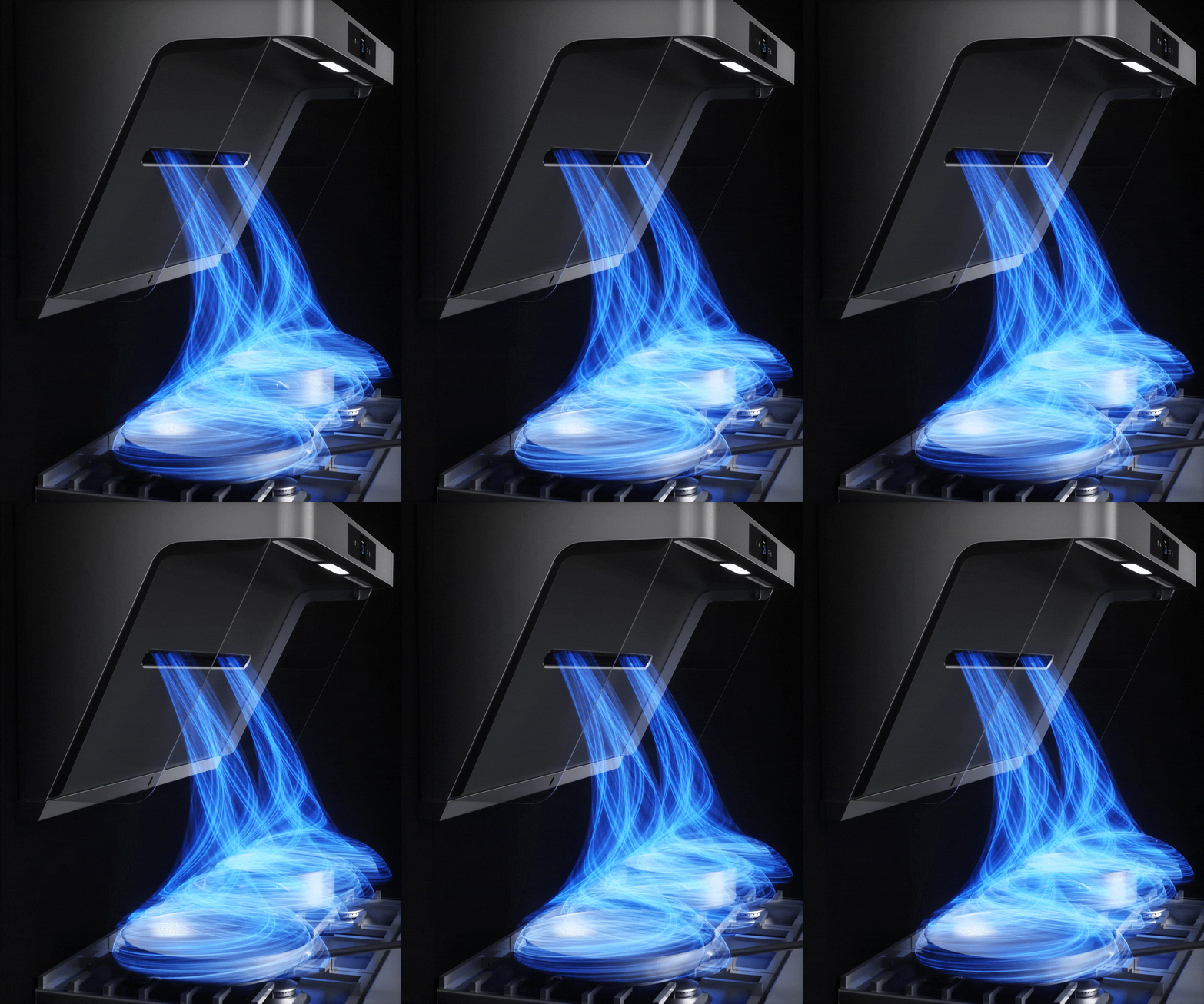
Pulls all smoke away from the user.

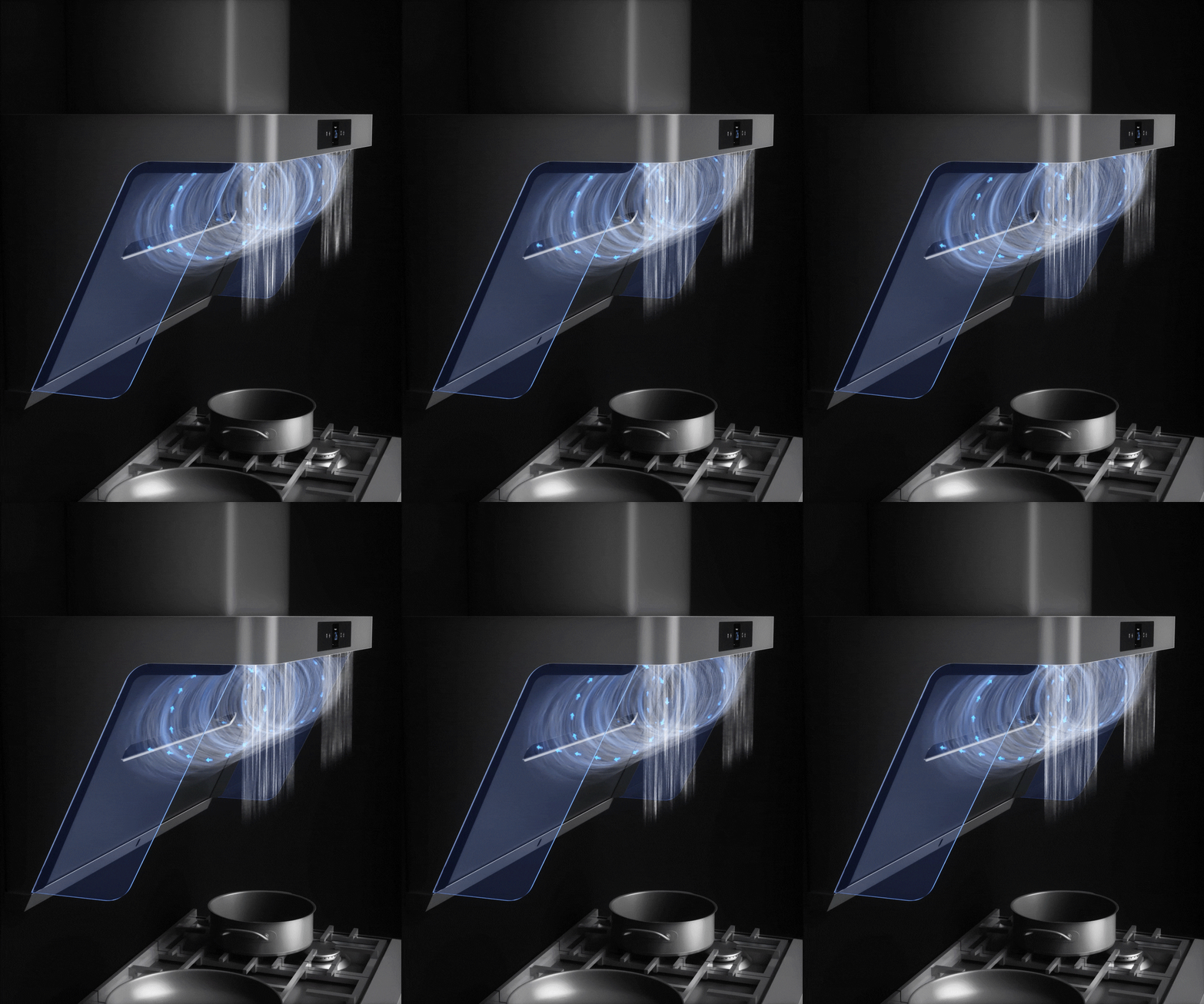
Isolate outside interference and keep PM2.5 and other pollutants contained within the purification chamber.
Stronger structure, lower noise. 60% greater strength and 30% better quiet performance.
Equipped with a military-grade laser sensor for 50% higher accuracy and 80% greater reliability.
Fully sealed to resist grease ingress, with a smart constant-airflow algorithm that helps maintain stable airflow over time.
Upgraded with a 3.1-inch dynamic full-color LCD screen, making key information visible at a glance.
Features a five-layer spray coating process for high heat resistance and easy cleaning.
Lotus-leaf-inspired technology helps resist grease buildup.
A large 79,932 mm² lighting area helps bring out the natural color of ingredients.
Arspura Vs. Others
“See how Arspura captures smoke closer to the source, while traditional hoods let fumes spread before they can be vented.”
Smoke Capture Distance
“A distance test showing how far Arspura can capture smoke before it spreads, highlighting the strength of its source-focused airflow.”
Steady Airflow
“Watch how Arspura maintains stable airflow during real cooking, helping reduce smoke escape even under changing kitchen conditions.”
Arspura Pulls A Tesla
“A bold demonstration of suction power—showing the strength behind Arspura’s high-speed airflow and smoke capture performance.”
No-Leakage Suction
“Built for source capture, Arspura helps lock in smoke before it rises and spreads, keeping kitchen air cleaner and fresher.”
Extreme Smoke Test
“An extreme smoke test designed to show how Arspura handles dense fumes with fast capture, strong airflow, and cleaner kitchen air.”
Professional testing, authoritative certification
Explore Products


Most traditional kitchen range hoods rely on a single mechanism: create negative pressure above the cooktop and draw air upward. Arspura's Triple Airflow Control Technology generates three coordinated airflow patterns simultaneously the moment the system starts — each targeting a different layer of the cooking environment.
The three airflow zones work as follows:
| Zone | Airflow Type | Function |
|---|---|---|
| ① Pan-Edge Smoke Lock Zone | Low-pressure cyclonic vortex | Four patented cyclones form directly above the cookware, containing smoke, PM2.5, and odor molecules at the source before they can rise |
| ② High-Speed Extraction Zone | High-speed rear-tilted airflow at 13–16 m/s | Pulls captured fumes away from the user and through the exhaust duct at 3–5× the velocity of conventional hoods |
| ③ Breathing Protection Zone | Dual low-speed containment air curtains | Top air curtains project downward to block fumes from reaching the face and nose, and isolate external disturbances — including crosswinds and movement — from disrupting the capture field |
Why this matters: Traditional hoods address only Zone ②. Without Zone ① and Zone ③, fine particles and odors escape the capture field before they can be extracted — especially in open kitchens. The triple-zone system is why Arspura achieves a 95% odor reduction rate and keeps PM2.5 rise within 75 μg/m³ during cooking.
Note: The top air curtains in Zone ③ project a gentle downward airflow — they are not high-suction inlets. Their function is containment and interference resistance, not primary extraction.
Performance isn't just about airflow design — it's built into every component. Here's how Arspura's key engineering choices translate into real-world advantages:
| Component | Arspura Specification | Benefit vs. Conventional |
|---|---|---|
| Volute Housing Assembly | Reinforced structure | 60% greater structural strength, 30% better noise reduction |
| PM2.5 Sensor Module | Military-grade laser sensor | 50% higher accuracy, 80% greater reliability vs. standard sensors |
| High-Speed BLDC Motor | Fully sealed, smart constant-airflow algorithm | Resists grease ingress; maintains stable airflow over time without decay |
| HD Display | 3.1-inch dynamic full-color LCD | Key data — PM2.5 levels, speed, time — visible at a glance |
| Silicone-Coated Panel (P1) | 5-layer spray coating process | High heat resistance, effortless wipe-clean, no sticky residue |
| Diamond-Frosted Glass Back Panel (P2) | Lotus-leaf-inspired surface technology | Naturally repels grease buildup |
| Soft Ambient LED Light | 79,932 mm² illumination area | Even, glare-free cooktop lighting that reveals true ingredient color |
The sealed BLDC motor deserves special mention: most kitchen exhaust fan motors are exposed to grease-laden airflow over time, causing gradual performance decay. Arspura's fully sealed motor combined with the constant-airflow algorithm means the hood maintains its capture velocity years into use — not just on day one.
IQV™ technology was first developed and validated in high-precision industrial ventilation environments — settings where particle capture accuracy, airflow stability, and contamination containment are mission-critical requirements, not consumer conveniences.
The core engineering principles — inclined quad-vortex cyclone formation, pressurized narrow-slot intake, and multi-layer containment airflow — were refined in industrial applications before being adapted for residential kitchen use.
This origin matters because it means IQV's performance claims are not based on consumer product testing alone. The underlying fluid dynamics have been stress-tested in demanding industrial conditions. What Arspura has done is translate that industrial-grade precision into a home kitchen ventilation system that over one million families worldwide now use daily.
IQV™ (Inclined Quad-Vortex) is Arspura's patented Dynamic Particle Capture Technology. When activated, it generates four counter-rotating low-pressure cyclones directly above your cookware, locking smoke, grease, odors, and PM2.5 particles at the source — before they rise, spread, or escape into your living space.
Here's the full three-stage process that makes Arspura's kitchen ventilation system fundamentally different:
Stage 1 — Source Locking
The narrow, elongated air intake slot generates ultra-high airspeed. Combined with side smoke-blocking panels, this creates four counter-rotating low-pressure vortices directly above the cooktop surface. Cooking pollutants — including invisible PM2.5 fine particles — are drawn into these cyclones and contained before they can rise.
Stage 2 — High-Speed Extraction
The 250W BLDC motor drives airflow at 13–16 m/s through the pressurized intake slot, instantly pulling captured pollutants through the exhaust duct and out of your kitchen. This capture velocity is 3–5× faster than the 3–5 m/s intake speed of conventional kitchen exhaust hoods
Stage 3 — Anti-Escape Air Curtain
Two upper air outlets project a precision air curtain that forms a sealed barrier between the cooking zone and the room. Any residual fumes that escape the primary cyclone field are intercepted here — preventing them from drifting into open-plan living areas.
The result: a sealed "anti-leakage triangle zone" that keeps your kitchen ventilation effective even during intense wok cooking, even in open-plan kitchens with crosswinds.
Traditional kitchen exhaust fans and cooking exhaust fans operate on a simple principle: spin a motor fast enough to create negative pressure, draw large volumes of air upward through a mesh filter, and push it out through a duct. This is called central negative pressure ventilation. The fundamental problem: this approach relies on volume, not precision.
| Traditional Range Hood | Arspura IQV™ | |
|---|---|---|
| Intake method | Wide-area surface suction | Narrow pressurized slot |
| Capture velocity | 3–5 m/s | 13–16 m/s |
| PM2.5 capture | Minimal — particles escape | Locked at source by cyclones |
| Odor removal | Partial | 95% odor reduction rate |
| Grease separation | Via mesh filter | Centrifugal force → oil cup |
| Filter required | Yes — must be cleaned/replaced | No filter, ever |
| Open kitchen performance | Poor — crosswinds cause leakage | Excellent — air curtain seals zone |
The core insight: a vacuum cleaner lifted slightly off the floor loses all suction — even at maximum CFM. What matters is not how much air you move, but how fast you move it at the capture point — right above your cookware.
CFM (Cubic Feet per Minute) measures the total volume of air a range hood moves per minute. A common rule of thumb: you need approximately 100 CFM per 10,000 BTU of cooktop output. A 40,000 BTU gas stove would need at least 400 CFM.
However, CFM is a deeply misleading metric for real-world kitchen ventilation performance. Here's why:
● No global standard. CFM is measured at zero static pressure in lab conditions — not in your actual kitchen with ductwork, bends, and backpressure. Real-world performance is always lower.
● Decay with distance. As the distance between the hood and the cooktop increases, suction velocity drops dramatically.
● Duct resistance compounds the loss. Every meter of ductwork, every 90° bend, and every narrow flue opening reduces effective airflow.
● Volume ≠ capture. Opening a window provides enormous "ventilation volume" — yet cooking odors and PM2.5 still fill the room.
Why Arspura focuses on capture velocity instead:
The P1 IQV concentrates airflow through a narrow pressurized intake slot, achieving 13–16 m/s at the capture zone — directly above your cookware. This is 3–5× the velocity of conventional cooktop vent hoods.
Think of it this way: a fire hose and a garden sprinkler can move the same volume of water per minute — but only one of them can knock something down.
Most kitchen exhaust hoods handle visible smoke — the large particles you can see. Odors are a different challenge entirely. Odor molecules are microscopic, travel with airflow, and cling to surfaces, fabrics, and hair long after cooking ends.
IQV technology addresses odors through three mechanisms working simultaneously:
1. Source containment — The four cyclones form a low-pressure zone directly above the cookware, preventing odor molecules from rising into the room in the first place.
2. High-velocity extraction — At 13 m/s, airflow is fast enough to capture and discharge odor-carrying particles before they diffuse into the kitchen atmosphere.
3. Anti-escape air curtain — The upper air curtain creates a physical barrier between the cooking zone and the open room, intercepting any odor molecules that escape the primary capture field.
The result: 95% odor reduction rate — verified under standard testing conditions. Whether you're stir-frying chili, cooking fish, or boiling strong-smelling broths, no lingering odors on clothes, hair, or soft furnishings.
The tempered glass smoke-blocking panels on either side of the hood serve a precise aerodynamic function — they are not decorative.
By forming physical walls on both sides of the cooking zone, the panels:
●Contain lateral spread — preventing crosswinds or body movement from disrupting the IQV capture field
●Extend the effective capture zone — pushing the low-pressure cyclone area closer to the cookware surface
●Reinforce the anti-leakage triangle — working together with the upper air curtain to create a sealed three-dimensional containment zone
This is why the P1 IQV performs reliably in open kitchens where traditional cooking ventilation systems fail — the panels neutralize the crosswinds and foot-traffic disturbances that cause conventional hoods to leak.
⚠️ Tempered glass has an extremely small probability of spontaneous breakage due to the tempering process. In the event of non-misuse spontaneous breakage, Arspura will replace the component free of charge. Avoid striking the glass with cookware or hard objects, especially at the corners.
PM2.5 refers to airborne fine particles with a diameter of 2.5 microns or less — about 1/30th the width of a human hair. These particles are generated in large quantities during cooking, especially high-heat stir-frying, grilling, and deep-frying.
They are dangerous because:
●They bypass the body's natural defenses — too small to be filtered by nasal passages or upper airways
●They penetrate deep into lung tissue, increasing long-term risk of respiratory disease and cardiovascular conditions
●They cause skin irritation and accelerate premature aging with repeated exposure
●They worsen pre-existing conditions such as asthma, COPD, and bronchitis
●They cling to clothing, hair, and soft furnishings, leaving persistent odors and surface contamination
This is why a home kitchen ventilation system that only removes visible smoke is insufficient. Visible smoke particles are large — PM2.5 is what remains invisible in the air and poses the real health risk.
According to indoor air quality standards, the 24-hour average PM2.5 concentration should not exceed 50 μg/m³ to meet healthy breathing standards.
| Level | PM2.5 Concentration | Classification |
|---|---|---|
| ● Excellent | 0–35 μg/m³ | Healthy — ideal for all occupants |
| ● Good | 35–75 μg/m³ | Acceptable for most people |
| ● Light Pollution | 75–115 μg/m³ | Sensitive groups may be affected |
| ● Moderate Pollution | 115–150 μg/m³ | Noticeable health impact |
| ● Heavy Pollution | 150–250 μg/m³ | Significant health risk |
| ⊖ Severe Pollution | ≥250 μg/m³ | Hazardous — avoid prolonged exposure |
Arspura's IQV kitchen ventilation hood keeps PM2.5 concentration rise during cooking within 75 μg/m³ — far below levels produced by traditional range hoods under equivalent cooking conditions.
Traditional range hoods use mesh filters to physically intercept grease droplets as air passes through. This works — but filters clog, require regular cleaning or replacement, and become a fire hazard when saturated with grease.
Arspura eliminates the filter entirely through centrifugal separation:
1.The high-speed BLDC motor and pressurized intake slot generate powerful airflow at 13 m/s
2.This creates intense centrifugal force as air spins through the system
3.Grease droplets — which are heavier than air — are flung outward by centrifugal force and directed into the oil cup
4.Clean air continues through the exhaust duct
The principle is identical to a washing machine's spin-dry cycle: centrifugal force separates heavier particles from lighter ones without any physical barrier needed.
The role of the Volute Housing Assembly: Arspura's reinforced volute housing is a structurally optimized chamber that guides high-speed airflow in a precisely controlled spiral path — amplifying the centrifugal force that separates grease droplets from the airstream and directs them into the oil cup. Without a well-engineered volute, high-speed airflow becomes turbulent, reducing separation efficiency and increasing operational noise. The optimized chamber geometry ensures that centrifugal separation remains consistent across all speed levels, from everyday simmering to full Turbo mode.
Result: lifetime filter-free design. Zero filter replacement costs. Zero monthly maintenance. 85% grease separation rate verified under standard testing.
Arspura uses a 250W Brushless DC (BLDC) motor with constant airflow control technology. This is a significant upgrade over the AC induction motors found in most conventional kitchen range hoods.
| Feature | BLDC Motor (Arspura) | Traditional AC Motor |
|---|---|---|
| Noise | Quieter, smoother operation | More mechanical noise and vibration |
| Energy efficiency | Lower power consumption | Higher energy draw for equivalent output |
| Speed control | Precise, continuously variable | Limited, step-based |
| Airflow stability | Constant — auto-adjusts to duct resistance | Drops as backpressure increases |
| Longevity | Longer service life, less wear | More mechanical wear over time |
The constant airflow advantage: As duct resistance increases — due to longer duct runs, more bends, or higher floor levels — the BLDC motor dynamically adjusts its output to maintain consistent performance. This is why the P1 IQV performs reliably on upper floors of apartment buildings where traditional hoods often struggle.
Static pressure measures how effectively a range hood overcomes duct resistance to maintain exhaust flow. It's the metric that determines real-world performance in your specific installation — not lab-condition CFM ratings.
The higher the static pressure, the better the hood performs in challenging configurations:
| Metric | Value |
|---|---|
| Operating Static Pressure | 600 Pa |
| Maximum Static Pressure | 1,100 Pa |
Combined with the BLDC motor's constant airflow technology, the P1 IQV dynamically adjusts output as duct resistance changes — maintaining consistent kitchen ventilation performance regardless of floor level or duct configuration.
For the most up-to-date product information, installation videos, and service policies, visit arspura.com.


